
LLC vs S Corp in 2026: The Full Tax Math for Solo Service Businesses
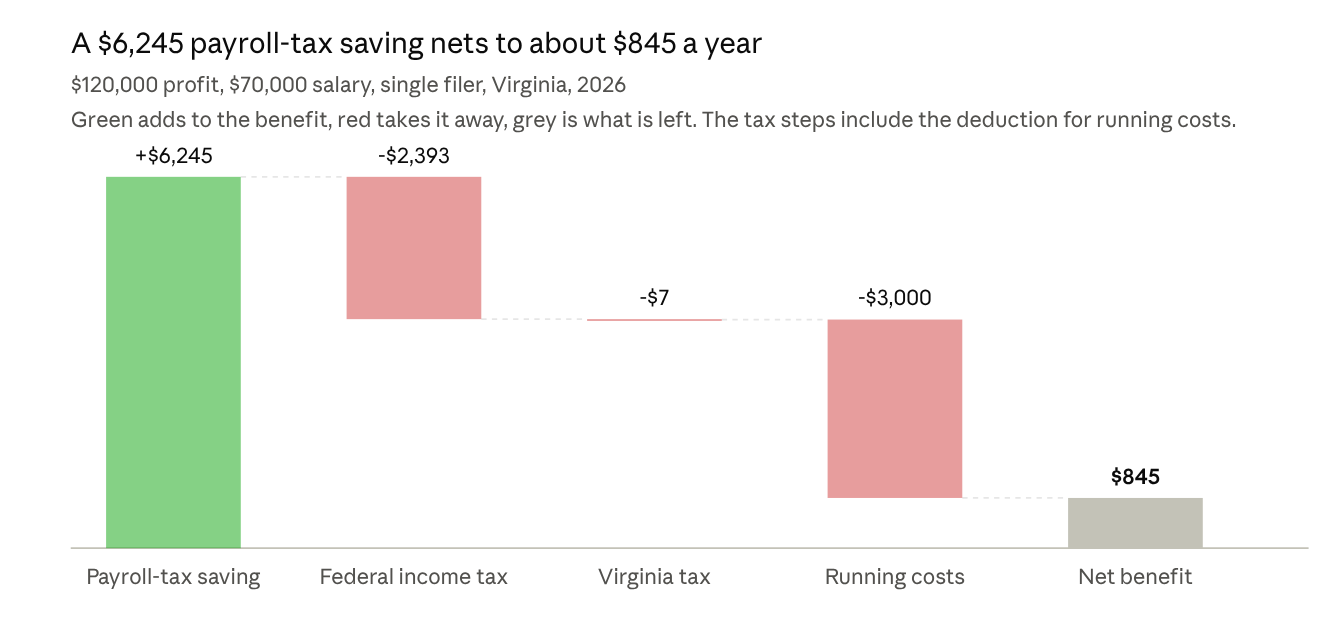
Depending on the salary you can defend and what it costs to run, the same $120,000 consulting business can lose about $1,700 a year as an S corp or save about $2,600. In our worked example, with a $70,000 salary, a $6,245 payroll-tax saving nets to about $845 a year. At $200,000 of profit with a $100,000 salary, the same math nets about
$5,000.
Most
S corp calculators stop at the payroll-tax saving. This guide walks through every step, with the math visible, so you
can see which inputs move the answer for your own business. The short version: the details decide it. The salary you pay yourself matters more than almost anything else. At moderate profit, once salary is set at a defensible level, the election is often close to break-even; it pays more clearly as profit grows well above a market-rate salary.
What an S corp election actually changes
An S corp election changes how your profit is split for payroll-tax purposes. It does not create a new kind of business or lower your income tax rate.
As a single-member LLC, all of your profit is subject to self-employment tax: 15.3% on 92.35% of net earnings (the 12.4% Social Security part stops at the 2026 wage base of $184,500; the 2.9% Medicare part does not). As an S corp, you split the profit in two:
A W-2 salary, which carries the same 15.3% (half paid by the company, half withheld from you).
Distributions of the remaining profit, which carry no payroll tax.
That split is the entire source of the saving. Everything else in this guide is about what the split costs you.
The worked example
One business, run through every step. The assumptions:
Business: solo consultant, single-member LLC, no employees
Net profit before owner pay: $120,000
S corp salary: $70,000
Filing status: single, no other income, standard deduction ($16,100 for 2026)
State: Virginia (5.75% top rate)
Tax year: 2026
Not modeled: retirement contributions, health insurance, other states
The salary is an illustration, not a recommendation. What counts as reasonable for your role is a separate question, covered below.
Step 1: The payroll-tax saving is $6,245
Earnings subject to payroll tax: LLC $110,820 (92.35% of $120,000); S corp $70,000 salary
Payroll tax at 15.3%: LLC $16,955; S corp $10,710
Difference: $6,245 less as an S corp
This is the number most calculators show. It is real, and it is the ceiling: every step below subtracts from it.
Step 2: Federal income tax goes up by about $2,393
Two things raise your federal income tax, and one pulls it back down:
The QBI deduction shrinks. The 20% qualified business income deduction applies to business profit, not to wages. Your $70,000 salary drops out of the base, so the deduction falls from $19,084 to $8,329.
Your deduction for payroll tax shrinks. As an LLC you deduct half of your self-employment tax ($8,478). As an S corp the company deducts only its half of the smaller payroll tax ($5,355). Your adjusted gross income rises by $3,123.
The running costs are deductible. The $3,000 of S corp costs in Step 4 reduces the company's profit, which offsets most of that rise. Your adjusted gross income ends up only $123 higher.
Adjusted gross income: LLC $111,522; S corp $111,645
QBI deduction: LLC $19,084; S corp $8,329
Taxable income: LLC $76,338; S corp $87,216
Federal income tax: LLC $11,506; S corp $13,899
Both cases sit in the 22% bracket, so the $10,878 jump in taxable income costs $2,393. That is more than a third of the payroll-tax saving, gone before any state tax or costs.
Step 3: Virginia tax barely changes (about $7)
Virginia starts from federal adjusted gross income, and the QBI deduction is taken after that line, so it never reduces Virginia tax. The state effect comes only from the change in adjusted gross income: the smaller payroll-tax deduction raises it by $3,123, and the deductible running costs lower it by $3,000. At 5.75%, the net $123 costs about $7 a year.
Virginia does not tax S corps at the entity level, and electing S status does not change your LLC's annual registration fee. Other states differ, some sharply. California charges S corps a 1.5% franchise tax, and New York City does not recognize the election for its own business tax. If you live outside Virginia, rerun this step with your state's rules.
Step 4: Running an S corp costs about $3,000 a year
An S corp is a separate tax filer with a payroll. That adds real, recurring costs:
Separate S corp return (Form 1120-S) and K-1, prepared by a professional: $1,500 to $2,500
Payroll service (quarterly 941s, W-2, state withholding filings): $600 to $1,200
Federal and Virginia unemployment tax on your salary: about $250
Working estimate used here: $3,000
The $3,000 is an assumption, not a quote. The biggest variable is the 1120-S itself: its fee depends on how complex the return is, including the state of your books, depreciation on equipment, income in more than one state, and whether there is more than one shareholder. Your own figures may be lower if you run payroll yourself, or higher if your books need cleanup each year. Either way, budget for them: they are the step most calculators leave out.
These costs are deductible business expenses, so part of each dollar comes back as lower income tax. Steps 2 and 3 already include that; the full $3,000 is subtracted here as cash out the door.
The result: about $845 a year, and it swings with salary
Computed from 2026 federal brackets, standard deduction and wage base; Virginia 5.75%; running costs are an estimate.
Roughly 86% of the headline saving is used up by the income-tax offset and the running costs. An $845 benefit is positive but modest, and a very different decision from $6,245.
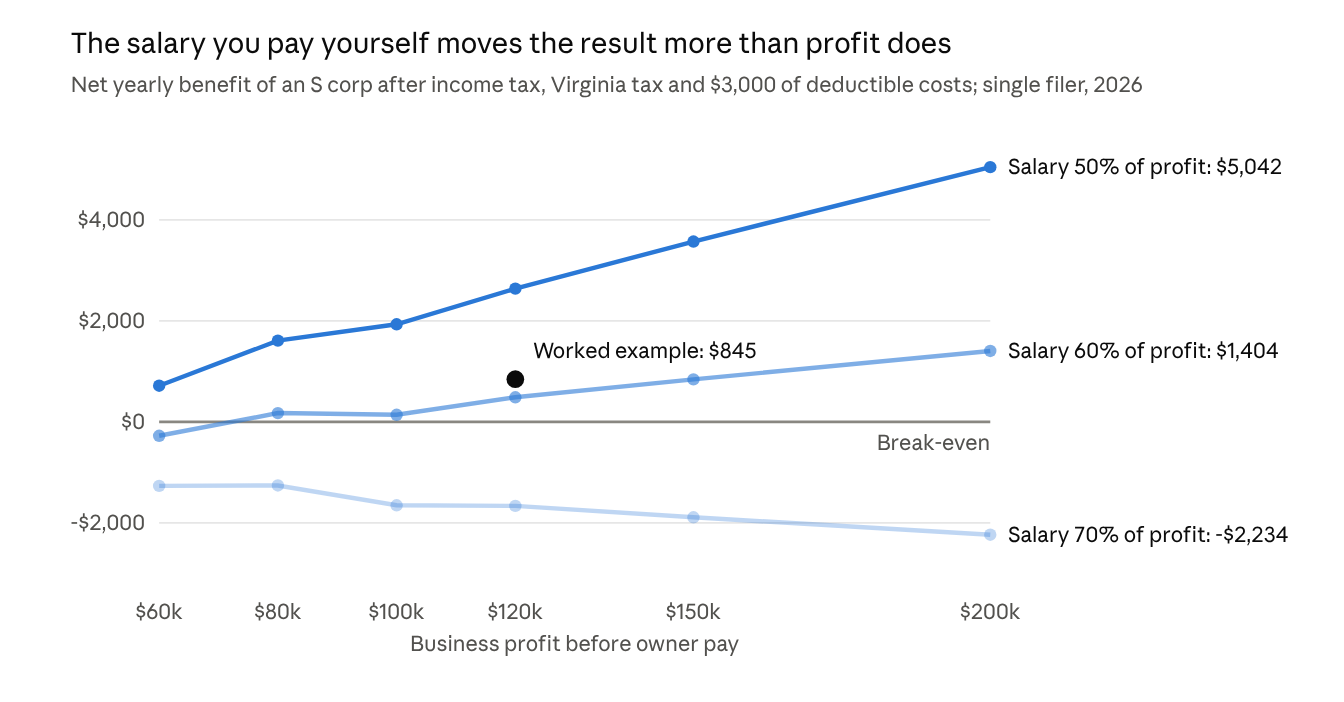
The result is sensitive to two inputs: your profit and the salary you pay yourself. The chart below reruns the same model across both, with salary set as a share of profit to show the range, not as a guideline.
Same model and assumptions; salary set as a share of profit to show the range, not as a guideline.
Two patterns stand out. A higher salary erases the saving quickly: at 70% of profit, the election loses money at every income level shown, and at 60% it stays under about $1,000 a year until profit passes $150,000. A lower salary saves more, but only if it is genuinely reasonable for the work you do, which is covered below.
When it clearly pays: $200,000 of profit
Same model, a bigger business: $200,000 of profit and a $100,000 salary. That salary is close to the $101,860 national median pay for management analysts (BLS, May 2025), a reasonable benchmark for many consultants.
Payroll-tax saving: +$12,934
Federal income tax: -$4,693
Virginia tax: -$199
Running costs: -$3,000
Net yearly benefit: about $5,000
The saving is bigger because more profit sits above a market-rate salary, and the running costs stay about the same, so they matter less as profit grows. The income-tax offset takes about 38% of the payroll-tax saving. This is the profile where an election usually earns its keep, as long as the salary is documented.
One more threshold to watch: consulting is a "specified service" business for the QBI deduction. This example stays under the 2026 limit ($201,750 of taxable income for single filers). Above it, consulting income starts to lose the QBI deduction, which changes the math again.
Reasonable compensation: the number that drives everything
If you work in your S corp, the IRS expects you to pay yourself a reasonable salary before taking distributions. The IRS says distributions to an officer "must be treated as wages to the extent the amounts are reasonable compensation for services rendered", and it can reclassify them if they aren't.
There is no safe-harbor percentage. Rules of thumb like "60/40" do not appear in the tax code. Courts look at factors including:
Your training, experience, duties and time spent in the business
What comparable businesses pay for similar services
How much of the company's income comes from your personal services, rather than from employees or equipment
For a solo service business, nearly all income comes from your own work, which pushes reasonable pay up. Document how you set the number: salary survey data, a job description, comparable postings. If the salary is ever questioned, that file is your answer. Our guide to setting and documenting a reasonable S corp salary walks through the method with a worked example.
Timing: the election deadline for 2027 is March 15, 2027
To be taxed as an S corp for a calendar tax year, file Form 2553 no more than 2 months and 15 days after the year begins, or at any time during the year before. For 2027, that means any time from now through March 15, 2027.
Miss it, and the election generally takes effect the following year. Late-election relief exists: you can request it within 3 years and 75 days of the intended effective date, but you must show reasonable cause and that every shareholder reported income consistently with S corp status. Planning ahead is far easier than relying on relief.
If you elect, payroll starts with your first salary payment of the year. Set up the payroll service before January, not after.
When an S corp usually doesn't make sense
The election is most likely to cost you money, or not be worth the work, when:
Profit is modest. Below roughly $100,000 to $130,000, the running costs and the income-tax offset eat most of the saving unless your reasonable salary is low.
Reasonable pay for your role is close to your profit. If the market rate for your work is most of what the business earns, there is little left to take as distributions.
Your income swings a lot. Salary is set in advance; a lean year can leave you paying payroll tax on wages the business struggled to fund.
You plan to max out retirement savings. Solo 401(k) employer contributions are based on W-2 wages for an S corp owner, so a lower salary lowers how much you can put away.
You live in a state that taxes S corps or ignores the election. Rerun Step 3 for your state.
This guide also leaves out health insurance, which an S corp handles differently (premiums run through payroll as wages). Those details can move the result in either direction, which is why the decision belongs in a conversation with your tax professional.
Next steps
The answer depends on your numbers, all of them. Three ways to get there:
Start with the free S Corp Election Readiness Checklist. Three pages covering eligibility, timing, reasonable compensation, payroll responsibilities and the numbers to gather before you talk to your tax professional.
Run your own numbers with the LLC-or-S-Corp Decision Kit ($29). A nine-page guide, a 2026 Excel estimator that includes the income-tax offset and running costs from this article, scenario tables and charts, and a salary evidence log.
Have a CPA run it for you. If you'd rather hand the decision to a professional, Geddes & Company, P.C., a CPA firm in Fairfax, Virginia, helps solo business owners with the entity decision, a defensible salary, payroll setup and the S corp return. Tax Planning Etc works closely with Geddes & Company. No referral fee is paid.
Close call on your numbers? Get a full projection.
At moderate profit the election is often near break-even, so the details decide it. Geddes & Company, P.C. can run a full projection with your actual salary, state and costs. Tax Planning Etc works closely with Geddes & Company. No referral fee is paid.
Updated October 3, 2026: we corrected our model to treat the S corp's running costs as deductible. That raised the worked example's net benefit from $144 to about $845 a year and the $200,000 example from about $4,300 to about $5,000.
This article is educational content from Tax Planning Etc LLC, a Virginia-licensed CPA firm that works closely with Geddes & Company. It is not tax, legal or financial advice for your situation, does not determine eligibility or recommend an election, and does not promise tax savings. Reading it does not create an accountant-client relationship.